


Indonesia’s e-commerce payout system is about to change significantly. Starting August 1, Tokopedia, Shopee, Lazada, and Blibli will be officially designated as withholding agents for corporate income tax (PPh Article 22) for eligible domestic sellers.
The tax rate is only 0.5%, but the calculation base is the total transaction value, not profit.
For Chinese brands operating through Indonesian entities, local stores, or platform accounts, this deduction will directly appear in every settlement cycle—becoming a new fixed cost embedded in the cash flow structure of Indonesia e-commerce operations, freight-linked trade, and even supply-chain models relying on Indonesia freight forwarding and DDP logistics (Indonesia DDP shipping).
1. Platforms Take Over Tax Withholding: Sellers Lose the Self-Filing Step
Indonesia’s Directorate General of Taxes confirmed on July 1 that Tokopedia, Shopee, Lazada, and Blibli will officially handle:
Income tax withholding
Tax remittance
Transaction reporting
The implementation date is August 1, with a one-month preparation window for system upgrades and seller notifications.
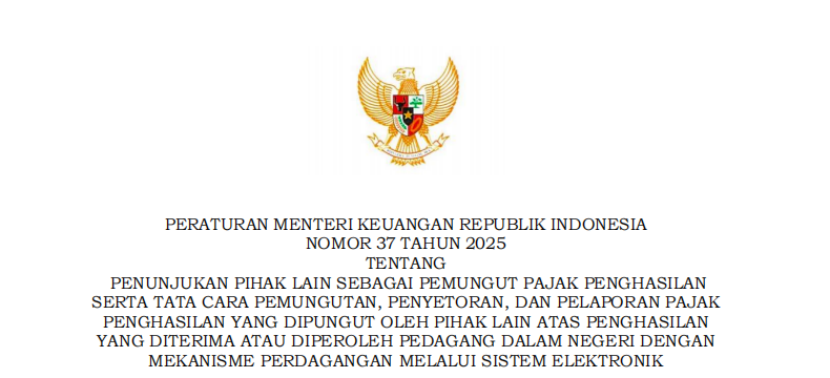
This arrangement originates from Minister of Finance Regulation PMK 37/2025.
While no new tax is introduced, the compliance mechanism has fundamentally changed:
Previously: sellers calculated and paid taxes independently
Now: platforms automatically deduct tax from settlement payouts
At the same time, platforms must report seller transaction data to tax authorities, including:
Sales volume
Tax identification numbers
Seller identity data
Settlement records
As a result, e-commerce transactions are increasingly integrated into a unified data system, significantly reducing the time gap between business activity and tax reporting.
2. 0.5% Deducted From Gross Revenue: Cash Flow Impact Appears on Settlement Day
The withholding tax rate is 0.5% of total transaction value, excluding VAT and luxury taxes.
It is calculated based on gross turnover, not net profit.
For example:
Monthly taxable turnover: 100 million IDR
Platform tax deduction: 500,000 IDR
While the amount may not dramatically affect per-order profitability, it creates a consistent gap between:
Displayed platform sales
Actual cash received
The withholding certificate will also be included in annual tax reporting.
Eligible micro and small businesses may use it to offset final income tax obligations, while others can treat it as a tax credit depending on their tax classification.
3. The 500 Million IDR Threshold: Cannot Be Split Across Multiple Stores
Businesses with annual turnover below 500 million IDR may submit a declaration to avoid platform withholding.
However, the threshold is calculated based on the aggregate revenue of a single taxpayer, not per account.
This means:
Multiple stores on Shopee, Lazada, or Tokopedia are combined
Online and offline revenue is included
Different platforms are aggregated under the same taxpayer identity
This directly impacts multi-store operations commonly used by cross-border brands and distributors operating in Indonesia.
Once the threshold is exceeded, sellers must update declarations by the end of that month, after which platforms will begin withholding automatically.
Finance teams will also need to adjust:
Revenue recognition
Tax accounting entries
Reconciliation processes
This creates additional complexity in Indonesia DDP logistics-driven commerce models, where cash flow timing is critical for inventory and freight planning.
4. Which Chinese Brands Are Affected?
The regulation applies to domestic Indonesian sellers, defined by:
Indonesian bank or financial account usage
Indonesian IP address or +62 phone number transactions
This means:
Pure cross-border sellers shipping directly from China may not automatically fall under the same rule
However, once operating through Indonesian entities or local accounts, they are fully subject to withholding
Chinese brands must carefully evaluate their operational structure:
Wholly owned Indonesian subsidiaries
Authorized local distributors
Third-party store operators
Agent-managed storefronts
Tax responsibility and cash flow impact differ significantly across these models.
Another often-overlooked factor is distributor structure:
If a local distributor runs the platform store, the tax withholding affects their cash flow first, and is later transferred through:
Procurement pricing
Rebates
Service fees
This means contract structures must be reviewed, especially regarding:
Tax-inclusive pricing
Cost allocation responsibilities
Settlement terms
5. Settlement, Documentation, and Pricing Must Be Aligned Before August
Businesses are advised to reconcile three key frameworks:
1. Entity Structure
Who owns each store
Tax ID linkage
Account ownership
2. Settlement Flow
Sales, refunds, coupons, VAT, and withholding breakdown
ERP reconciliation and accounting mapping
3. Contract Structure
Who bears tax costs
Who receives withholding certificates
Whether pricing includes tax adjustments