


From spot checks to full inspections, where is the bottom line for Indonesia's customs clearance?
Starting May 22, news of a "complete suspension of customs clearance at Jakarta's Tanjung Priok Port" quickly spread throughout the cross-border logistics industry.
The report stated that a customs officer responsible for assigning inspection tasks had died unexpectedly,
causing approximately 90% of containers at the port to require queuing for opening. Combined with over a thousand containers already backed up,
customs operations in Jakarta have nearly come to a standstill.
This news quickly drew significant attention from numerous companies and sellers involved in Indonesia's double-clearance and freight forwarding services,
prompting many cross-border sellers to worry about whether their goods could smoothly enter the country and whether delivery delays might worsen.
However, as of the time of writing, Indonesian customs has not issued any official announcement regarding a "customs clearance suspension,"
and frontline reports from various sources are conflicting. Some sellers claim that Jakarta port is indeed severely congested,
while logistics companies specializing in Indonesian freight forwarding and dual-clearance services report that containers arriving after May 22 have already seen normal clearance cases.
Although rumors may vary, the fact remains that Indonesia has significantly tightened its customs clearance procedures and sharply increased inspection rates.
According to Indonesian media reports, on May 20, President Prabowo publicly warned during a plenary session of the House of Representatives in Jakarta
that if customs officials fail to improve work efficiency and accelerate bureaucratic reforms, the Finance Minister must replace the leadership of the customs agency.
He emphasized, "We must have the courage to thoroughly reform all institutions and continue building a clean and efficient government,"
and instructed ministers to take strict measures against violators.
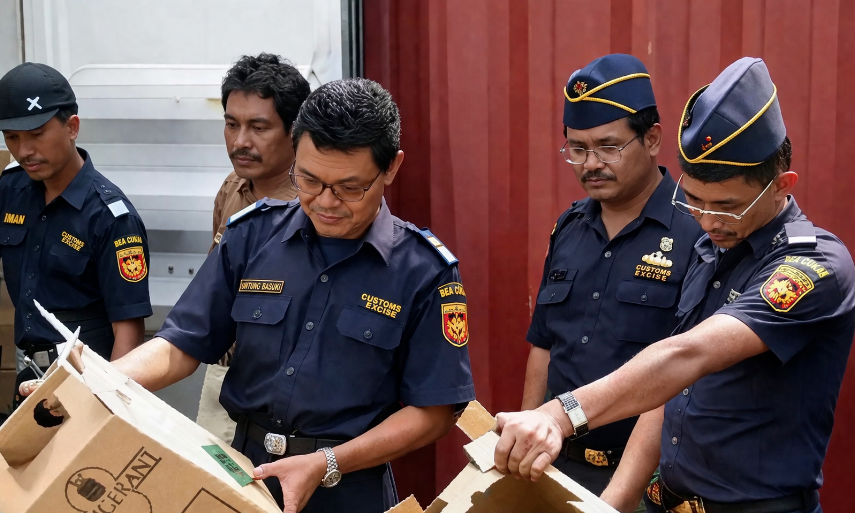
This high-level statement quickly reached the operational levels of Indonesia's major ports and customs authorities.
According to industry insiders, Semarang Port has now implemented 100% inspections, upgrading from the previous simple verification of
customs declarations to opening and inspecting each container by product model, with queuing times starting at one week.
While Jakarta Port has not completely shut down, inspection procedures have clearly tightened, leading to prolonged overall
clearance times—general cargo typically takes around one month to clear, with significant fluctuations.
For cross-border sellers relying on Indonesia's dual-clearance channels, this means that the traditional logistics model of
"tax-inclusive and clearance-inclusive" now faces greater uncertainty. Some Indonesian freight forwarders have begun to
regulate their container loading pace and reduce the proportion of high-risk product orders to avoid potential inspection risks.
Some logistics providers reported that currently, after clothing shipments are loaded into containers in Indonesia, it typically takes about 25 days to reach the Jakarta warehouse.
Overall, port conditions in Indonesia have slightly improved compared to the peak period in April,
and some Indonesian freight forwarders have resumed normal shipping operations. However,
significant disparities remain across ports: Jakarta continues to operate slowly, while Semarang remains on "red alert."
In addition to long-term high pressure, short-term disturbances should also not be overlooked.
The official first day of Eid al-Adha in 2026 is set for May 27, with Indonesian holidays concentrated between May 25 and June 1,
allowing most people to take six to nine consecutive days off, including weekends. This will significantly impact customs inspections, port operations,
warehouse container pickups, and last-mile deliveries, potentially further delaying already postponed logistics timelines and sharply increasing the risk of cargo congestion.
May is already a month with fewer working days in Indonesia, and combined with the impact of the extended holiday,
issues such as port staff shortages and delayed document approvals are expected to surge. As a result, last-mile delivery times may be extended by an additional one to two weeks.
For sellers relying on Indonesia's double-clearance services, it is particularly important to prepare inventory in advance and schedule shipments wisely.
More notably, according to market sources, Indonesia may launch another round of strict inspections covering the entire supply chain from docks to warehouses starting June 8,
with enforcement intensity potentially exceeding that of the previous 30-day special operation.
Since the major reshuffle of customs leadership at the beginning of the year, Indonesia's import regulation has entered a phase of "normalized high pressure."
Freight forwarders have suspended container loading, customs brokers are slowing down operations,
and overseas warehouses are closing temporarily to avoid risks—these measures are gradually shifting from temporary emergency responses into industry norms.
Against this backdrop, an increasing number of cross-border enterprises are reevaluating their cooperation models with Indonesian freight forwarders,
focusing particularly on the logistics companies' customs clearance capabilities, compliance qualifications, and the stability of local resources.
The era of relying on low-cost channels and "gray double-clearance" is rapidly coming to an end.
For cross-border sellers, it is essential to rationally plan inventory replenishment in the short term to avoid blind rush for warehouse space.
In the long run, Indonesia's strict enforcement against illegal imports will not ease, making full-chain
compliance no longer an option but a fundamental requirement for entering the Indonesian market.