


BPOM certification is an official certification issued by Indonesia’s National Agency of Drug and Food Control (Badan Pengawas Obat dan Makanan).
It regulates the quality and safety of products such as cosmetics, pharmaceuticals, and food products. For companies planning to enter the Indonesian market,
especially sellers using Indonesia double clearance services or Indonesian freight forwarders, BPOM certification is extremely important.
1. The Importance of the Indonesian Market and the Role of BPOM
As one of the most important countries in Southeast Asia, Indonesia has a huge market and strong consumer potential, especially in the cosmetics industry.
To ensure that products sold in Indonesia meet national safety standards,
the Indonesian government established BPOM to oversee legislation, standardization, and supervision.
This means that even if products are imported through Indonesia double clearance channels or Indonesian freight forwarder services,
goods cannot be cleared smoothly without BPOM certification.
BPOM’s main responsibilities include:
Establishing and updating policies, standards, and procedures;
Supervising implementation and conducting laboratory testing;
Inspecting production and distribution facilities and performing product sampling;
Issuing certificates and permits.
Obtaining BPOM certification is a prerequisite for legally entering the Indonesian market and can also
improve customs clearance efficiency through Indonesian freight forwarders.
2. The Importance of BPOM Certification for Cosmetics
For cosmetics companies, BPOM certification is not only a market access permit but also an important guarantee of brand reputation and consumer trust.
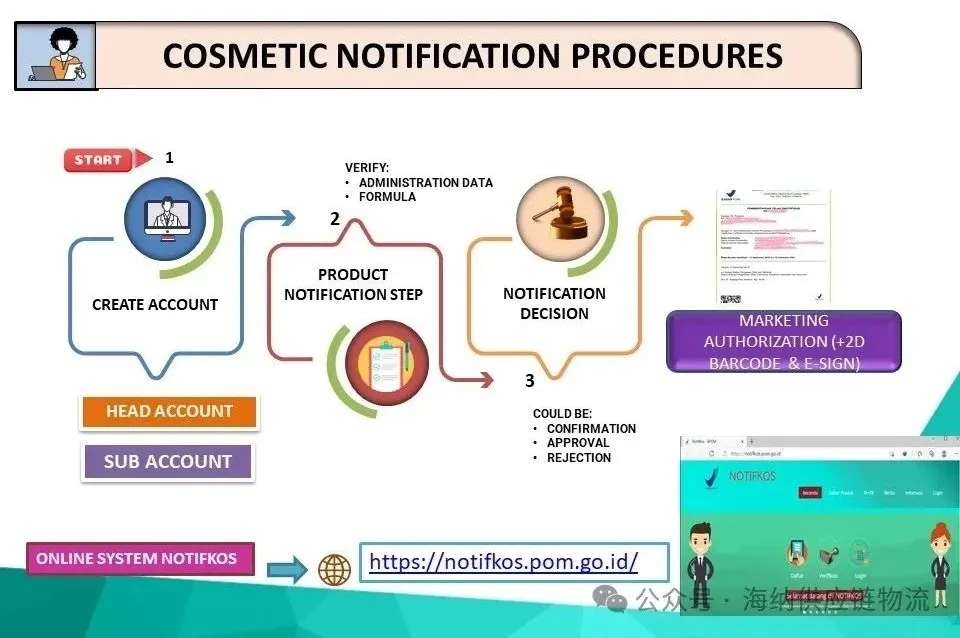
All cosmetics must pass BPOM registration and approval before they can be sold in Indonesia.
The registration process includes submitting production licenses, quality management system documents, product formulas,
and other necessary supporting materials. Even when using Indonesia double clearance services, these compliance requirements cannot be bypassed.
3. BPOM Application Process and Required Documents
Applying for BPOM certification requires submitting a series of detailed documents and materials, including company documents and product samples.
The entire process usually takes around 35 working days.
Applicant Requirements
The applicant company must be a locally registered Indonesian company;
Foreign companies must apply through a legally authorized local business entity, such as an importer or distributor.
Manufacturing Standards
Manufacturers must possess international certifications such as GMP, HACCP, ISO22000, FSSC, or BRC.
Company and Product Documents
Required documents include:
Tax Number (NPWP);
Business License (SIUP/NIB);
Identification documents;
Import Identification Number (API);
GMP certificates and notarized Certificate of Free Sale;
Trademark certificate;
Directors’ declaration letter;
Authorization letter.
Sample Testing and Submission
Product samples must be provided for inspection and testing;
After document preparation, notification applications must be submitted for BPOM approval.
Labeling and Packaging Requirements
Product packaging must contain complete labeling information, including:
Product name;
Batch number;
Size;
BPOM distribution number;
Manufacturer and importer information;
Ingredients;
Instructions for use;
Expiration date.
It is also recommended to use trademarks that are already registered in Indonesia. Warehouses used by importers must meet BPOM inspection requirements.
Product Registration Validity
Product registrations are valid for 3 years;
Any formula changes or claim modifications require a new registration;
All cosmetics must comply with Indonesian National Standards (SNI) and cosmetic regulations.
4. Suggestions for Cross-Border Sellers
For businesses relying on Indonesian freight forwarders and Indonesia double clearance services,
BPOM certification is not only a compliance requirement but also a guarantee for smooth customs clearance.
Without certification, goods may be detained or delayed at customs even if they arrive quickly through logistics channels, affecting the overall supply chain efficiency.
Completing BPOM registration in advance can make logistics and customs clearance processes smoother while
improving product competitiveness and brand credibility in the Indonesian market.